Stone · Melbourne · Since 2014
Limestone Sealing Melbourne, done properly.
Porous, soft, and worth protecting early.
From $22/m² inc GST $20 + GST Clean and seal. Stain removal and restoration are quoted from photos.
Quicker still: text us a photo for a ballpark.
The short answer
What to know before you seal limestone.
Limestone is the most absorbent stone we regularly seal, and the most rewarding to seal early. It drinks up anything spilled on it, so a glass of red on unsealed limestone is a problem within minutes rather than hours. It is also acid-sensitive, which is a separate issue that no sealer solves.
What goes wrong
Staining that goes deep, fast.
The pore structure means spills do not sit on the surface waiting to be wiped, they wick down into the stone. Leaf tannin, red wine, oil and even hard water all leave marks that are into the body of the stone rather than on it. Once it is deep, cleaning the surface does nothing, and it needs drawing back out with a poultice.
The process
How we handle limestone.
- 1
Test how thirsty it is
We test absorption in a few spots before quoting, because limestone varies enormously and it determines how much product the job actually needs.
- 2
Draw out what is already in there
Existing deep stains come out with poultices rather than cleaning, and that is a slow process. We will tell you which marks we expect to shift and which we do not.
- 3
Seal in multiple coats, wet on wet
Porous stone takes sealer until it stops taking it. Coats go on wet on wet until the stone is satisfied, not to a fixed number.
- 4
Buff off the excess
Sealer left sitting on the surface of limestone dries to a haze. The excess gets buffed back while it is still workable.
Questions
Limestone: what people ask.
How do I know if my limestone needs sealing?
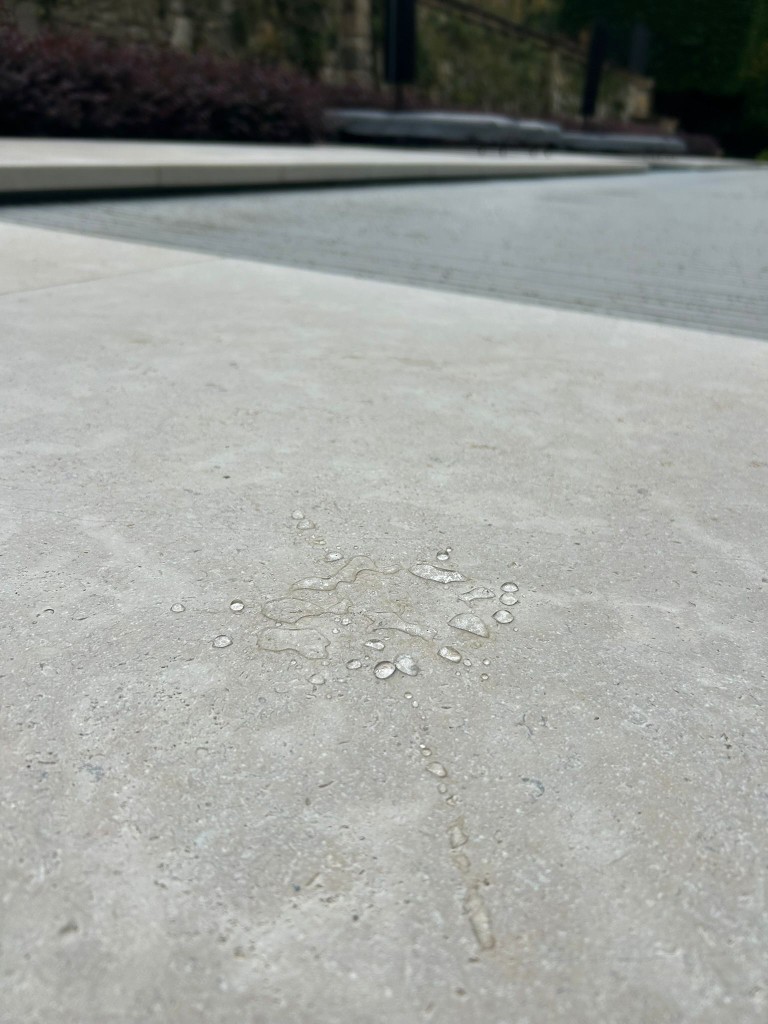
Pour a small amount of water on it in an out-of-the-way spot. If it darkens within a minute or two, the stone is drinking and it is unsealed or the seal has gone. If it beads and sits, you have still got protection. It is a test you can do yourself any time.
Will sealing stop my limestone etching?
No. Etching is an acid reaction that eats into the calcium carbonate, and it is physically different from a stain. Lemon juice, wine, vinegar and some cleaning products will dull the surface regardless of sealer. What the sealer does is stop the colour soaking in at the same time.
My limestone has gone dark and blotchy. Is it ruined?
Usually not. Dark blotching on outdoor limestone is normally organic growth and embedded grime rather than damage, and it comes back with the right clean. Send a photo and we can usually tell you which one you have got.
Can limestone be sealed in winter?
It can, but the stone has to be genuinely dry through, not just dry on top, and Melbourne winters make that harder. Trapping moisture under a sealer causes a hazy finish. If we do not think conditions are right we will say so rather than take the job and hope.
How often does limestone need resealing?
It depends far more on exposure than on the product. Full sun, pool chlorine and heavy foot traffic wear a seal much faster than a covered indoor floor, and anyone quoting one number for all of it is guessing. Use the water test above: when it stops beading, it is due.
Get a price
Get your limestone price.
Three ways to start. Whichever suits you, you'll hear back within 24 hours.